
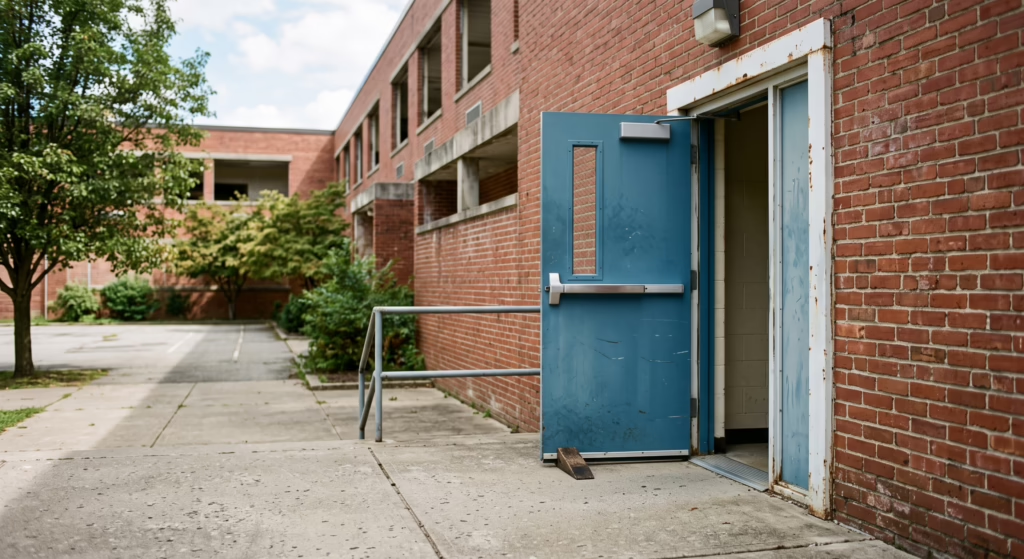
Every security gap in a school building shows up in the first four weeks of the year, and almost none of them show up on a summer punch list. An empty building in July behaves. A building with 600 people moving through it on a bell schedule does not, and the difference is where the real findings are.
Colorado districts have been back for a couple of weeks now. This is the window where the list is still fresh and the fixes are still cheap.
Propped doors are the finding, every time
The single most common failure is a secured door held open with a rock, a wedge, or a trash can.
It is never malicious. It is a delivery at 10am, a coach moving equipment, a staff member who parks on the far side and does not want to walk around, or the pickup line at 3pm. The door gets propped, everyone forgets, and it stays open until someone happens by.
A secured entry vestibule at the front of the building does nothing about this. The district paid for a controlled front entrance and the side door by the gym has been open since second period.
The fix is door position monitoring on exterior doors, which reports when a door is held open past a set interval. It is inexpensive relative to the rest of a security project and it is routinely the first thing cut from a budget. If your building has a vestibule but no monitoring on the other doors, that is the gap worth closing before anything else gets added.
Credentials issued in August are the ones nobody tracks
August is when a school issues the most credentials and documents them the worst.
New teachers, paraprofessionals, substitutes, student workers, coaches, activity sponsors, food service staff, and custodial contractors all need access in the same three weeks. The people doing the issuing are also doing twelve other things. Cards get handed out and recorded later, or not at all.
Then the year proceeds and nobody revisits it. The result is a credential list that no longer matches the staff list, and a district that cannot answer who had access to a given door on a given date. That question tends to arrive after an incident, when the answer needs to already exist.
Late September is a good time to reconcile the access list against the current staff roster while the August issuance is recent enough that people remember it. Districts that do this once a year find it takes an afternoon. Districts that have never done it find it takes considerably longer the first time. For the wider picture on district systems, see school security in Northern Colorado.
The front office starts waving people through
Visitor management works in an empty building and fails at 8:05am.
If the check-in process takes ninety seconds and eight parents arrive at once, the line reaches the door and the office staff start making judgment calls to clear it. That is not a discipline problem, it is a throughput problem, and the answer is not asking staff to be stricter.
Watch the actual morning peak and count. If the process cannot clear the busiest ten minutes of the day, it will get bypassed on the busiest ten minutes of the day, which are exactly the minutes it exists for. Sometimes the fix is a second station. Sometimes it is pre-registration for recurring visitors like regular volunteers and vendors. Sometimes it is moving where the scanner sits.
Doors that do not latch
A door that closes but does not latch reads as secure to everyone walking past it and opens with a pull.
Closers fall out of adjustment, strikes get worn, weather stripping compresses, and older frames shift with the season. Summer heat and dry air move wood doors enough to matter, and the ones that were fine in June are not always fine in September. This is the least visible item on the list because there is nothing to see. The door looks shut.
Walking every exterior door and pulling on it is a twenty-minute job in most buildings and it belongs on a schedule, not on a hunch.
Camera views that moved
Cameras get commissioned in summer and then the building changes around them.
Landscaping fills in and covers an angle. A new banner or sign goes up in front of a lens. A portable classroom or storage container arrives in a parking lot and blocks a drive aisle view. Furniture gets rearranged in a commons area. A camera bumped by a ladder during summer maintenance is aimed three degrees off and nobody noticed, because it still records, just not the thing it was placed for.
Pull up every camera view once in September and compare it to what it was supposed to cover. It is the cheapest audit in the building and it is the one most likely to find something.
What the first drill tells you
Drills surface the problems that only appear under a real procedure: a door that does not release the way people expected, an intercom zone that does not reach a wing, a staff member who cannot lock a classroom from inside, radios that do not carry into the gym or the far end of a hallway.
The value is in what gets written down afterward. A drill finding that stays in someone's head is not a finding. Getting those items into a list, with the ones requiring hardware separated from the ones requiring procedure, is what turns a drill into a work order and eventually into a budget line.
Fix it now or carry it to spring
Small items handled in September are maintenance. The same items in January are emergency calls, and the same items in June are a capital request that has missed its budget cycle.
Colorado's budget calendar makes this concrete. Public entities work toward proposed budgets in mid-October, so anything requiring real money needs to be scoped in the next few weeks to make the request. Anything smaller, closers, strikes, camera realignment, door monitoring on a handful of openings, is service work that can happen now.
ESI works with schools and districts across Northern and Southern Colorado, including buildings where another company installed the original system. If your first month produced a list, we will walk the building and turn it into a scoped plan at no cost. Call (970) 999-1681 in Fort Collins or (719) 602-7336 in Colorado Springs, or use the contact form.
Frequently asked questions
What are the most common school security problems found early in the year?
Propped exterior doors, credentials issued during August onboarding that never got recorded, visitor check-in that cannot handle the morning peak, doors that close without latching, and camera views obstructed by landscaping, signage, or rearranged furniture. Almost all of them are only visible once the building is carrying real traffic.
How do you stop staff from propping doors open at a school?
Treat it as a reporting problem rather than a compliance problem. Door position monitoring alerts when a door is held open past a set interval, which turns an invisible gap into something the office knows about within a minute. Also worth asking why the door gets propped, since a delivery route or a distant staff parking lot often has a scheduling or credential answer.
When should a district audit its access control credentials?
Late September works well, because August issuance is recent enough that people still remember who received what, and because it precedes the budget scoping window in October. Reconcile the credential list against the current staff roster and against contractor and vendor agreements, which are the entries least likely to be reported when they change.
Can a security integrator work on a system another company installed?
Yes. ESI services access control, camera, intrusion, and fire alarm systems installed by other integrators across Colorado, and can move a district from break-fix onto a scheduled maintenance agreement. The first step is documenting what is on site, which on older campuses has usually drifted from the drawings.
Last updated: August 2026