
Most commercial security systems work fine right up until they don’t. A camera goes offline. An access control reader stops responding. An alarm sensor drifts out of calibration. When that happens with no service agreement in place, the facility manager is starting from scratch: find someone who can respond, negotiate an emergency rate, and hope the system logs what they need in the meantime.
A security system maintenance service agreement is supposed to prevent that situation. But what does one actually include, and is it worth it for your facility?
What a security maintenance agreement is
A commercial security maintenance agreement is a contract between a facility and a security integrator that covers ongoing system upkeep in exchange for a predictable annual or monthly fee. The specifics vary by integrator and by the scope of the system being covered, but the core premise is the same: you pay for proactive service rather than waiting until something breaks.
This is sometimes called a service plan, a service contract, or a managed service agreement depending on the integrator. The terminology doesn’t matter much. What matters is what’s actually in the agreement.
What most maintenance agreements include
Coverage varies, but a well-structured maintenance agreement for a commercial security system typically covers some combination of the following.
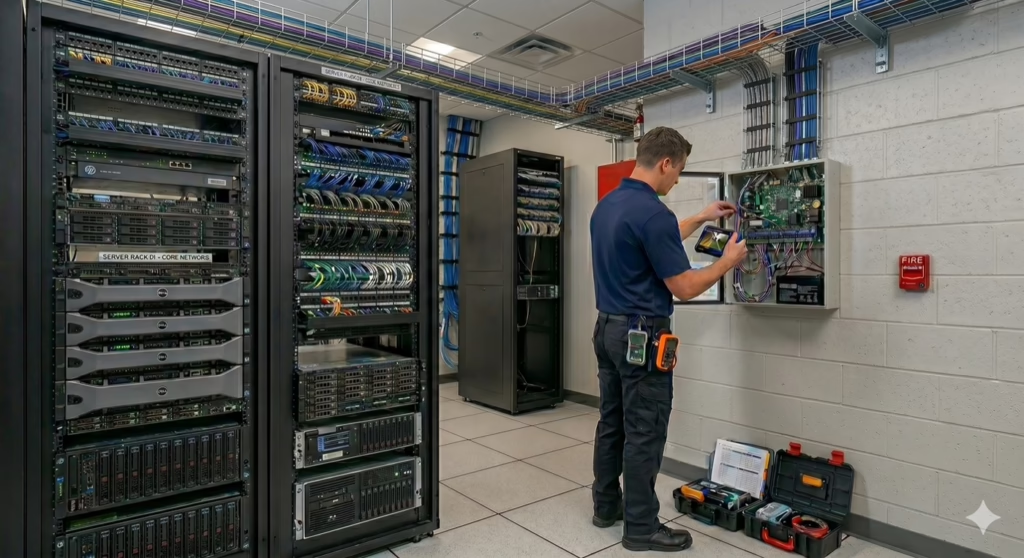
Scheduled preventive maintenance visits are the foundation. A technician comes to your site on a regular cadence, inspects the system, identifies components that are degrading, cleans cameras and sensors, verifies that recording is functioning correctly, and documents the visit. The frequency depends on the size and complexity of the system and the terms of the agreement.
System health monitoring covers ongoing remote visibility into the state of your system. Rather than waiting for a user to notice a problem, the integrator’s monitoring tools flag issues as they appear. A camera that stops recording at 2am gets flagged before anyone needs the footage, not after.
Software and firmware updates are often included or at minimum handled by the integrator rather than left to facility staff. For enterprise platforms like Genetec or Avigilon, keeping the software current is not optional. Updates often contain security patches and new features, and running outdated firmware on networked cameras or access control hardware is a real vulnerability.
Priority service response means that when something does fail, your call moves to the front of the queue. The specific response time depends on the agreement terms. For a healthcare facility or a school where access control or surveillance is tied to safety protocols, the difference between a four-hour response and a two-day response is significant.
Documentation and compliance records are worth more than most facility managers realize until they need them. Healthcare environments, schools, and government facilities are often required to demonstrate that their security systems are maintained and tested. An integrator running a maintenance program produces that documentation automatically as part of the service.
What maintenance agreements typically do not cover
Being clear about what is not included matters as much as knowing what is. Most agreements cover labor for scheduled visits and sometimes for service calls, but parts are a separate question. Some agreements include replacement parts up to a certain value; others bill parts separately at a discounted rate. Ask specifically before signing.
Major system upgrades, new equipment additions, and work outside the covered scope of the original system are almost always billed separately. A maintenance agreement keeps your existing system healthy. It does not replace a failing system or expand it.
Who benefits most from a maintenance agreement
Not every security installation needs a formal maintenance agreement. A small office with a basic system and low operational risk can often manage with periodic ad hoc service calls.
The math changes for larger or more complex installations. Multi-building facilities, healthcare environments, schools, retail operations with continuous recording requirements, and any facility where system downtime creates a compliance or liability exposure typically see clear value in proactive service coverage. The cost of a single emergency service call, at emergency labor rates with parts, often equals or exceeds the cost of an annual maintenance agreement on a mid-sized system.
We provide security system maintenance agreements for commercial facilities across Northern and Southern Colorado, covering access control, video surveillance, intrusion detection, and fire alarm systems. We work with Genetec, Axis, Gallagher, Avigilon, AMAG, and Salto platforms. We can also service systems we did not originally install, though we assess the system first before putting it under a maintenance contract.
If you’re evaluating service coverage for an existing system in Northern or Southern Colorado, talk to an expert. We can assess what’s covered and what a maintenance agreement would actually cost for your installation.
The difference between proactive service and break-fix
Break-fix is exactly what it sounds like: you call when something breaks, and you pay to fix it. There is nothing wrong with this model for low-stakes installations. But for facilities where security system uptime matters operationally, break-fix has real costs beyond the repair bill.
The footage that wasn’t captured because a camera failed two weeks ago and nobody noticed. The audit that found no maintenance records for a system that a compliance requirement says should be documented. The Monday morning access control failure that nobody can address until Tuesday because the integrator’s emergency rates aren’t in the budget.
Preventive maintenance agreements don’t eliminate failures. They reduce their frequency, catch problems before they become operational incidents, and give facility managers a known cost structure instead of unpredictable repair bills.
Frequently asked questions
Can I get a maintenance agreement for a system that a different integrator originally installed?
Often yes, but not automatically. A reputable integrator will want to assess the system before committing to a maintenance contract on it. This typically involves an on-site visit to verify the equipment, software versions, configuration, and overall system health. If the system is in reasonable condition and uses platforms the integrator supports, a maintenance agreement is usually available. We do this regularly across Northern and Southern Colorado for facilities that have switched integrators or inherited systems from previous tenants.
How often should a commercial security system be professionally serviced?
At minimum, once per year for most commercial installations. Systems with more demanding uptime requirements, including healthcare facilities, schools, and multi-site operations, benefit from more frequent visits. Twice per year is common for mid-sized to larger systems. The right cadence depends on the age and complexity of the equipment, the operating environment, and any compliance requirements specific to your industry or facility type.
What happens if something fails between scheduled maintenance visits?
That depends on whether your agreement includes service call coverage. Most maintenance agreements include priority response for system failures, meaning your call is handled before calls from customers without a contract. Some agreements include a set number of service calls per year at no additional labor charge; others bill service calls at a reduced rate for contract customers. Get clarity on this before signing.
Is it worth paying for a maintenance agreement if my system is relatively new?
A new system is less likely to need reactive repairs, which is exactly when a maintenance agreement is most cost-effective to enter. Agreement pricing reflects the current health of the system. A newer installation with clean equipment will carry a lower annual cost than one with aging hardware or deferred maintenance. Waiting until the system is older and more prone to failure generally means paying more, not less.
Does a maintenance agreement cover cybersecurity for networked cameras and access control systems?
Firmware and software updates are typically part of a maintenance agreement, which addresses a meaningful portion of network-connected device security. But a maintenance agreement is not the same as a comprehensive cybersecurity program. If your facility handles sensitive data, particularly in healthcare or government environments, firmware patching through a maintenance agreement should be one layer of a broader IT security posture, not the whole answer.
If your facility is running a security system without a maintenance agreement, a site walk is the fastest way to understand your options. We’ll document what’s installed, assess system health, and give you a clear picture of what coverage would include. Get a Free Site Walk.