
A card reader fails at a main entry point on a Friday afternoon. A camera goes offline over a long weekend. Without a security system service contract, there’s no committed response time, no pre-negotiated rate, and no priority in anyone’s dispatch queue. You’re a new ticket, competing with every other break-fix call that came in the same day.
Most facilities in Northern and Southern Colorado run their security systems this way until a failure makes the cost visible. By that point, the conversation about service agreements usually sounds different. We covered the scope of those agreements in what a commercial security maintenance agreement actually covers. This post compares the two service models directly.
The full cost of break-fix is harder to see than the invoice
The repair bill is the easy part to measure. Labor, parts, and travel show up on a line item. What doesn’t show up: the emergency rate premium when the call comes on a Saturday, the operational disruption while a main-entry reader is down, and the recorded coverage gap if cameras go offline before an incident.
Facilities on break-fix tend to run systems until failure. Firmware goes unpatched. Battery backups degrade past their rated life. A reader that intermittently misreads cards gets rebooted rather than diagnosed. None of these are dramatic failures on their own. Over time, they produce a system that’s more likely to fail at the worst moment and more expensive to restore to reliable operation.
Response time is also demand-dependent. When integrators are stretched (after weather events, during busy construction seasons, over holidays), customers without contracts wait behind those who have them. Emergency labor rates move accordingly.
A service contract sets the terms before something breaks
Most agreements cover scheduled preventive maintenance visits, a defined response window for service calls, and a fixed labor rate that doesn’t change based on when you call. You’re not making an authorization decision at 10 p.m. on a Friday. That decision was already made when you signed the agreement.
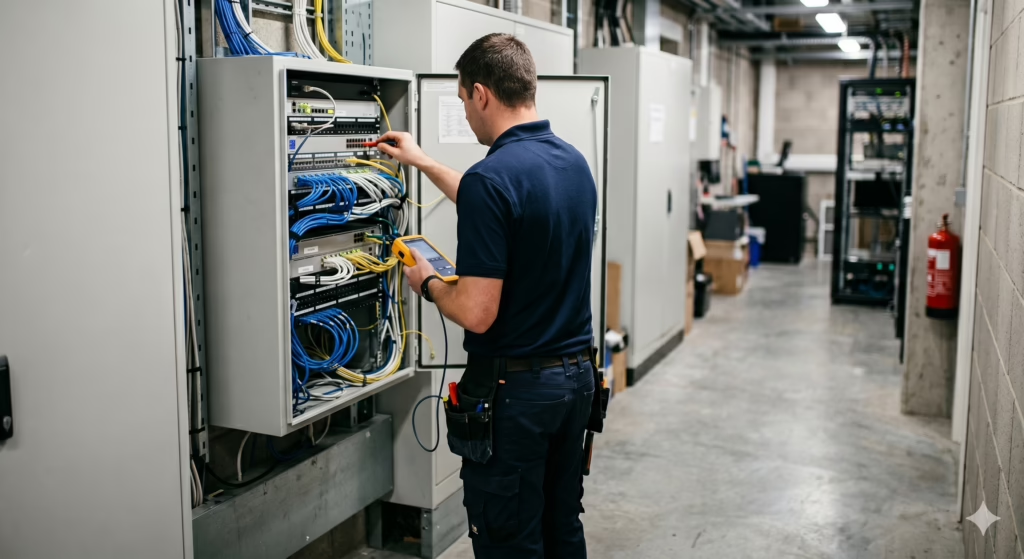
The preventive maintenance visits are where the long-term value shows up. A technician on a scheduled visit finds the camera with early lens degradation, the battery backup approaching end of life, the reader that’s starting to intermittently fail. Catching those before they fail is cheaper than an emergency call, and the failure doesn’t happen the week before an audit or an inspection.
For facilities with compliance obligations (healthcare, government buildings, schools), service contract documentation carries weight on its own. Scheduled maintenance records and system check logs support audit requirements in a way that ad-hoc repair invoices don’t.
If you’re already evaluating a service agreement and want a structured walkthrough of your current systems, talk to an expert about what coverage would look like.
Where the math actually shifts
Break-fix looks cheaper in any year nothing significant fails. That’s the reason most facilities stay on it.
The calculation changes when you account for after-hours and weekend labor premiums, downtime costs during repairs, and the compounding effect of systems running past their maintenance intervals. Facilities that have been through a significant unexpected failure (a controller board replaced on a holiday weekend, a camera system with untracked degradation that missed an incident window) tend to view the service contract cost differently after the fact.
The risk profile also depends on the facility. A small commercial office and a Larimer County government building don’t have the same consequences when access control goes down. Healthcare facilities, schools, and government buildings across Colorado carry real operational and liability exposure from security system gaps that a commercial warehouse may not. The cost model should reflect the facility, not just the line-item comparison.
Our view: most commercial facilities that have been operating for more than two or three years, running systems with any meaningful complexity, are better served by a maintenance agreement than break-fix. The break-fix math looks fine until it doesn’t, and the failure that changes the calculation tends to be expensive.
What to ask before committing to a service agreement
Coverage varies significantly between providers. Before signing:
- What does a scheduled maintenance visit cover: which systems, which components, at what frequency?
- What’s the defined response window for priority calls, and what happens if the integrator misses it?
- Does the agreement include parts, or is it labor only?
- What’s the path if a repair requires manufacturer support?
Manufacturer authorization matters specifically for service work. An authorized Genetec or Gallagher integrator has direct access to manufacturer support channels, current firmware through official distribution, and warranty service on covered components. A non-authorized integrator can often get a system running. Long-term support is a separate question.
ESI holds authorizations from Genetec, Gallagher, Axis, Avigilon, AMAG, and Salto. We service facilities across Northern Colorado (Fort Collins, Loveland, Greeley, Windsor, and the surrounding area) and across Southern Colorado, including Colorado Springs and Pueblo. For facilities that want a single agreement covering both maintenance and ongoing operations, our managed site agreements extend beyond the standard service contract scope. If you want to understand what coverage would look like for your specific systems and site, a site assessment is the right starting point.
Frequently asked questions
What does a commercial security service contract typically include?
Most agreements cover scheduled preventive maintenance visits, priority response for service calls, and defined labor rates. Some include parts; others are labor only. Ask specifically what a maintenance visit covers (which systems, which components, how often) and what the committed response window is for emergency calls. Vague terms on those two points are worth clarifying before you sign.
Is break-fix ever the right model for commercial security?
For some facilities, yes. A recently installed system at a small site with simple infrastructure and low operational stakes may not generate enough service volume to justify a maintenance contract. Break-fix tends to underperform when systems are complex, multi-building, or subject to compliance requirements, or when a security gap carries real liability exposure. The right answer depends on the facility.
Can ESI service a system they didn’t originally install?
Yes, in most cases. For systems built on platforms where ESI holds manufacturer authorization (Genetec, Gallagher, Axis, Avigilon, AMAG, and Salto), we can provide full ongoing support including maintenance and priority service. For other platforms, we evaluate the specific system and will tell you directly whether we’re a fit.
How do I know when a system should be replaced rather than maintained?
When repair costs on aging equipment approach replacement cost, or when a system can no longer receive security patches and firmware updates, that’s generally the threshold. A site assessment gives you a clear picture of where each component is in its lifecycle. We do these across Northern and Southern Colorado. Call us if you want an evaluation before committing to a service agreement or deciding to replace equipment.
Talk to us about service coverage
If your facility is running on break-fix and you want to understand what a service agreement would cover and cost, call ESI at (970) 999-1681 (Northern Colorado) or (719) 473-2660 (Southern Colorado), or Get a Free Site Walk.