
Healthcare facilities have a video surveillance problem that office buildings and warehouses do not: the same cameras that protect patients, staff, and medication can also capture protected health information. Get the placement and the storage right and the system supports security and compliance at once. Get it wrong and the system becomes a liability. For a hospital, clinic, or medical campus in Colorado, the design decisions matter as much as the hardware.
What makes healthcare video surveillance different?
Healthcare video surveillance has to balance security coverage against patient privacy in a way few other facility types require. A medical building mixes public areas, clinical areas, and restricted areas in one footprint, and each one calls for a different approach to where cameras go and who can see the footage.
The public zones (entrances, lobbies, waiting rooms, corridors, parking) need the same coverage any commercial facility does. The clinical and patient-care zones are where healthcare diverges. Cameras that can see into exam rooms, treatment areas, or patient rooms risk capturing protected health information and compromising patient dignity. The design has to protect the building without turning the cameras into a privacy exposure.
Where do cameras belong in a medical facility, and where don't they?
Cameras belong in public and transitional spaces and in high-risk restricted areas. They do not belong anywhere a patient receives care.
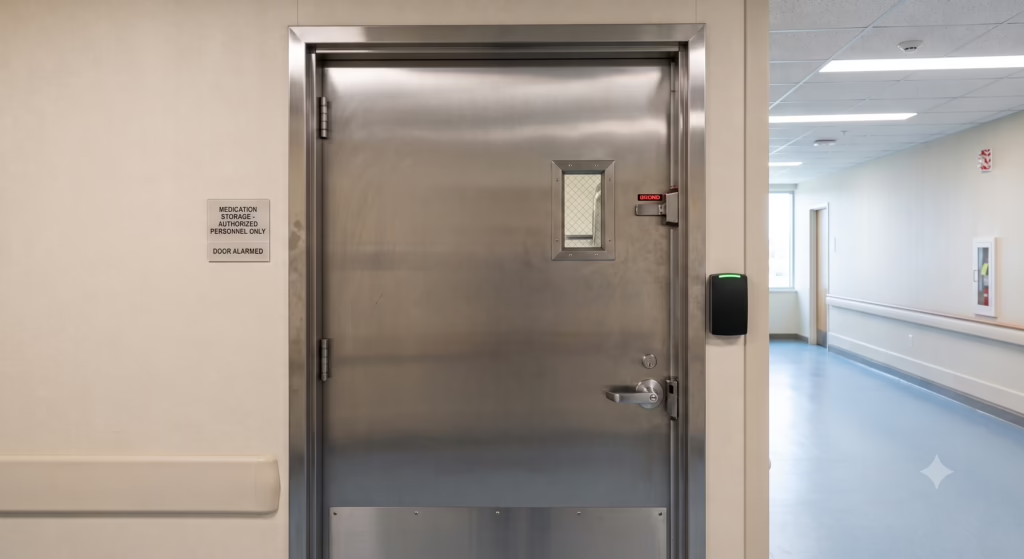
Coverage that holds up in a healthcare setting includes building entrances and exits, lobbies and check-in areas, waiting rooms, public corridors, elevators and stairwells, parking lots and structures, loading docks, pharmacy and medication storage, and the emergency department entrance. These are the areas where incidents, theft, and access disputes happen, and where footage is most often needed.
Patient rooms, exam rooms, treatment areas, and restrooms are off limits. Behavioral health units are a separate conversation, because some monitoring is clinically necessary there, and that calls for a deliberate design built with the clinical team rather than a default camera placement. The line to hold everywhere else is simple: cover the spaces people pass through and the assets that need protecting, not the spaces where care is delivered.
How does HIPAA affect a healthcare video system?
Video that captures patients or patient information falls under the same obligation to protect that information as any other record, which means the footage itself has to be secured, access-controlled, and retained deliberately. This is a design and compliance question for your facility's privacy officer, not legal advice from an integrator, but the security system has to be built to support whatever policy your compliance team sets.
In practice that means the recorded video is stored on a secured system, access to the footage is restricted to authorized staff and logged, and retention follows a defined schedule rather than keeping everything indefinitely. The video management platforms we install support role-based access and audit logging of who viewed what, which is what lets a compliance team prove the footage was handled correctly. Placement does the first half of the privacy work by keeping cameras out of care areas. Access control on the footage does the second half.
How long should a healthcare facility keep surveillance footage?
Most healthcare facilities retain commercial surveillance footage on an incident-review timeline of 30 to 90 days, with 60 days a common default, unless a specific regulation, accreditation standard, or internal policy requires longer. The right number depends on how long it realistically takes for an incident to surface and be investigated.
Some areas justify longer retention. Pharmacy and medication storage, where a discrepancy may not appear until an audit, often warrant a longer window than a general corridor. Retention is also a storage decision: more cameras, higher resolution, and longer windows all consume recording capacity, so the system has to be sized for the policy. We cover the retention question across commercial settings in our Colorado video surveillance buyer's guide.
Why integrate video with access control in a healthcare facility?
Integrating video with access control turns two separate systems into one investigation tool, because a door event and the camera covering that door are tied together. When a restricted door opens, the system can link the credential used to the footage of who used it, which is what makes an after-the-fact investigation fast instead of guesswork.
That integration matters most in the areas healthcare facilities worry about. Medication storage, records rooms, and labs combine a controlled door with a camera so access is both restricted and recorded. Pediatric and infant care areas use the same pairing for protection programs. Behavioral health and emergency departments benefit from cameras and controlled access working together during an incident. We cover the access control side of this in our guide to access control for healthcare facilities in Northern Colorado.
What this looks like across Colorado
We install and service healthcare video surveillance for medical campuses, hospitals, surgery centers, behavioral health facilities, and clinics across Northern and Southern Colorado, from the Fort Collins and Loveland medical corridor to the healthcare campuses around Colorado Springs. The cameras are authorized Axis and Avigilon hardware, running on video management platforms including Genetec, Milestone, and Hanwha, with the platform chosen to fit the facility's size and existing systems rather than forced to a single product.
The local part is dispatch and service. We run technicians out of offices in Fort Collins and Colorado Springs, so a medical facility on the Front Range is not waiting on a service truck from out of state when a camera covering a controlled door goes down. We also service healthcare video systems other integrators installed.
Frequently asked questions
Can hospitals legally use video surveillance in Colorado?
Yes. Hospitals and healthcare facilities use video surveillance in public and restricted areas for security. The constraint is placement and handling: cameras should not capture patient care, and footage that contains patient information has to be secured, access-controlled, and retained according to the facility's compliance policy. The security design supports that policy; it does not replace your privacy officer's judgment.
Where should cameras not be placed in a medical facility?
Cameras should not be placed in patient rooms, exam rooms, treatment areas, or restrooms, where they would capture patient care and protected health information. Behavioral health units are an exception that requires a deliberate design built with the clinical team. Public areas, corridors, entrances, parking, and high-risk restricted areas like medication storage are where coverage belongs.
How long should a healthcare facility keep security camera footage?
Most facilities keep footage 30 to 90 days, with 60 days a common default, unless a regulation, accreditation standard, or internal policy sets a longer window. High-risk areas like pharmacy and medication storage often warrant longer retention because discrepancies can surface late. Retention is also a storage sizing decision based on camera count and resolution.
Can ESI integrate cameras with our existing access control?
Yes. We integrate video surveillance with access control so door events and camera footage are tied together for investigations, and we service systems other integrators installed across Northern and Southern Colorado. A site walk establishes what your current systems are and how they can be integrated.
If you manage a healthcare facility in Fort Collins, Colorado Springs, or anywhere along the Colorado Front Range and your surveillance system needs a design that protects the building without compromising patient privacy, call ESI at (970) 999-1681 in Northern Colorado or (719) 602-7336 in Southern Colorado, or schedule a free site walk at esicorp.com.
Last updated: June 2026