
Most security upgrades that get denied are not denied on price. They are denied because the request arrived without enough behind it to evaluate, and the reviewer had an easy reason to defer it another year. In Colorado, that decision happens on a calendar that starts moving in August, and a request that arrives in October is a request for the cycle after next.
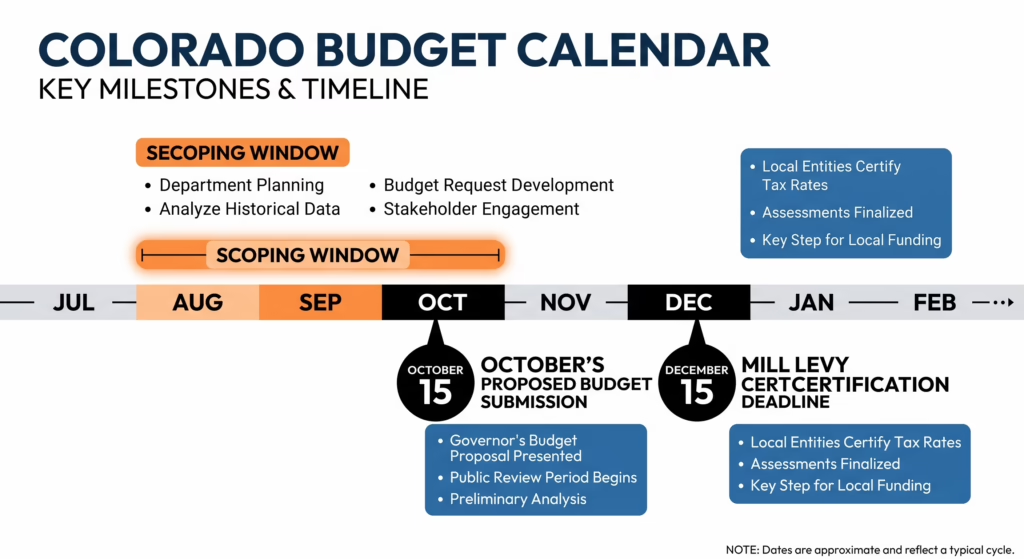
The Colorado budget calendar works backward from October 15
Colorado statute requires local government budget officers to submit a proposed budget to the governing body by October 15, with mill levies certified by December 15. Working backward, department heads are assembling their requests in August and September. Anything that lands after those requests are consolidated is competing for a supplemental appropriation rather than a line in the budget. For school districts working the same window, see what the first month of school exposes in a security system.
The private sector runs on a different clock but a similar shape. Companies on a calendar fiscal year usually close capital requests in October or November for the following January. Either way, the useful window is now.
That timing is why scoping matters more than persuasion. A facility manager who calls an integrator in September and asks for a number can get one. A facility manager who calls in November is asking someone to rush a design so it can be submitted late, which is how bad numbers end up in budgets.
Requests get cut on scope, not cost
The most common reason a security request dies is that nobody reviewing it could tell what they were approving.
A camera count with no storage plan behind it gets sent back, because the reviewer knows the number is incomplete. Thirty cameras is a hardware cost. Thirty cameras at 30 days of retention, with the storage, licensing, and network capacity to support it, is a project. The first version invites a question. The second answers it.
Door counts have the same problem. Twelve doors sounds like twelve readers. It is twelve readers, the controllers to support them, door hardware that may or may not be reusable, cable pathway that may not exist, software licensing, and the fire alarm integration that lets those doors release during an alarm. A request built on the reader count alone will be short, and the shortfall shows up as a change order after the money is already allocated.
The requests that survive review have a design attached. Not a quote. A design that shows what is being installed, why, and what it costs to run after it is installed.
What to include in the request
Lead with the problem the system solves, in operational terms rather than security terms. A reviewer who is not a security person can evaluate "we cannot produce an access log when HR asks who entered the records room" more easily than "we need improved access control."
Then cover:
Scope and design. Opening counts, camera counts and placements, retention period, platform, and how it integrates with what already exists. If the facility runs a system that is being extended rather than replaced, say so, because extending an existing platform is a materially different number than a rip and replace.
Phasing. Most security projects can be split across fiscal years without wasting money, if the phasing is designed in from the start. Head-end and infrastructure in year one, additional openings and cameras in year two, is a common and defensible structure. A phased request is easier to approve than a large single-year request, and it gives the reviewer somewhere to compromise other than denial.
Operating cost. Software licensing, monitoring, and maintenance are recurring, and a request that omits them looks incomplete to anyone who has approved one before. Including the annual cost also protects you from a system that gets installed and then never budgeted for again, which is how facilities end up with cameras nobody has serviced in six years.
Procurement path. For public entities, whether the work can go through cooperative purchasing changes the timeline. ESI participates in OMNIA Partners, which lets eligible government, education, and commercial buyers procure against an already competitively bid contract rather than running a separate solicitation. We also hold preferred vendor agreements with three Colorado municipalities. Naming the vehicle in the request removes a procurement objection before it gets raised.
What this looks like in practice
We replaced the camera system at the State of Colorado Integrated Document Solutions facility in Denver, consolidating 69 cameras onto a single managed platform and keeping the system almost entirely off the State network. That project was delivered by our Colorado Springs office.
The part relevant to a budget request is the network isolation. It was a design decision made early, and it is the kind of detail that changes how an IT reviewer responds to a capital request. A security proposal that arrives without addressing where the cameras live on the network will get routed to IT and sit there. One that answers it up front does not.
The same applies to Larimer County, the City of Fort Collins, the City of Loveland, and Northern Colorado Regional Airport, where the work has to fit an existing procurement structure and existing IT standards rather than assuming a blank slate.
Get the number before you need it
A site walk costs nothing and produces the document a budget request needs. We walk the facility, document the openings and coverage gaps, and deliver a written design with pricing. Whether that becomes a project this cycle or next is a separate question from whether the number is real.
Facilities across Northern and Southern Colorado are doing this now because the October 15 deadline does not move. If a security upgrade needs to be in your next budget, call ESI at (970) 999-1681 in Fort Collins or (719) 602-7336 in Colorado Springs, or use the contact form.
Frequently asked questions
When should a Colorado facility manager start a security budget request?
August and September, for a budget cycle that closes with proposed budgets due October 15 and mill levies certified December 15. Department requests are consolidated before those dates, so a request that starts in October is competing for a supplemental appropriation or waiting for the following year. Private sector calendar-year budgets usually close capital requests in October or November.
What makes a security budget request get denied?
Incomplete scope more often than cost. A camera count without a retention and storage plan, or a door count without controllers, cable pathway, licensing, and fire alarm integration, gives the reviewer a reason to defer. Requests with a written design behind them, including recurring operating cost, are the ones that clear review.
Can a commercial security project be split across two budget years?
Yes, and phasing is often the difference between approval and denial. A common structure is head-end equipment, infrastructure, and cable pathway in year one, then additional openings and cameras in year two. Phasing has to be designed in from the start, because a project split after the fact usually costs more in total than one designed to be built in stages.
Does a security integrator charge for a budget estimate?
ESI does not. We walk the facility, document what is there, and provide a written design and pricing at no cost. For public entities, we can also identify whether the work can be procured through an existing cooperative contract such as OMNIA Partners, which affects the timeline more than most people expect.
Last updated: August 2026