
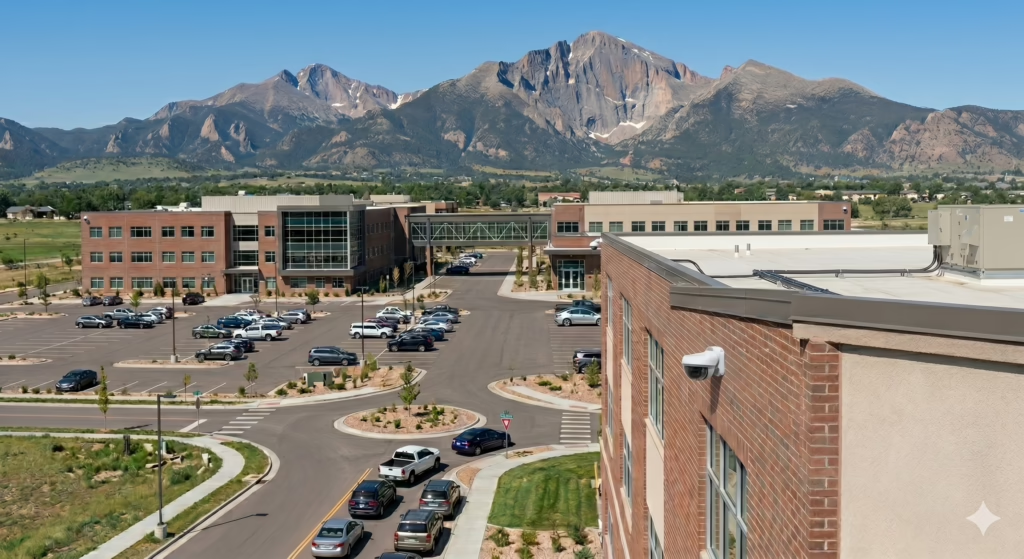
Most Fort Collins businesses already have cameras. The question is whether those cameras are doing what the business actually needs them to do. A 10-year-old analog system covering a back door is not the same thing as a modern IP video surveillance system that protects a multi-building campus, gives a property manager remote visibility, and feeds investigation-ready footage when something goes wrong. The gap between those two setups is where most facility decisions get made, and where most of the cost overruns happen when the wrong system gets installed.
This post covers what commercial video surveillance looks like in Fort Collins today, what to look for when you're upgrading or specifying a new system, and the issues we see come up most often on local projects. For the full buyer's guide to IP cameras, VMS platforms, storage, and retention, see our guide to commercial video surveillance in Colorado.
What commercial video surveillance includes today
A commercial video surveillance system is the combination of cameras, recording hardware or cloud storage, network infrastructure, and management software that captures and stores video of a facility. The components used to be sold separately. They no longer are. A modern system is specified, installed, and serviced as one platform, and the network it runs on is as important as the cameras themselves.
Most new installations in Northern Colorado use IP cameras feeding into either a network video recorder (NVR) on site or a cloud-managed video platform. Axis and Avigilon dominate the commercial side of the market in this region, and we're authorized for both. Analog and hybrid systems still exist, mostly in older buildings where the wiring was run before IP became standard. They can be maintained, but the long-term direction is clear: when a system needs replacement, it gets replaced with IP.
Why image quality is no longer the only thing that matters
A 4K camera is useless if the system can't find the clip you need in under five minutes. The benchmark for a useful commercial video surveillance system has shifted away from raw resolution and toward how usable the footage is when an incident happens.
Four things determine that:
Search speed. Modern video management software can pull all motion events at a specific door across a 12-hour window in seconds. Older systems require someone to scrub through hours of footage manually. For a property manager or operations director responsible for a 200,000-square-foot facility, that difference is the difference between getting an answer and giving up.
Analytics. People-counting, line-crossing alerts, vehicle detection, and license plate recognition are standard features on current Axis and Avigilon platforms. Whether you need them depends on the facility, but the option is there.
Remote access. Facility managers expect to log in from a phone or laptop and see live feeds across multiple buildings or sites. A system that requires you to be on-site to view footage is a system that gets used less, which means it gets noticed less when something fails.
Storage retention. Most commercial policies and insurance requirements call for 30 to 90 days of retained footage. Storage gets sized to that retention target, the camera count, the resolution, and the recording mode (continuous or motion-triggered). Undersize the storage and you discover the gap during an investigation, which is too late.
What Fort Collins buildings tend to require
Fort Collins has a mix of facility types that drive specific surveillance requirements. The CSU-adjacent commercial corridor and the Harmony Road business parks have a high concentration of office and light-industrial buildings, many of them multi-tenant. Owners and property managers in those buildings need shared common-area coverage, tenant-controlled interior coverage, and clean separation between the two, both technically and in terms of who can access what.
The medical district around Prospect and Lemay carries different requirements: longer retention windows, integration with access control at controlled-substance storage and clinical areas, and a higher standard for image quality at patient-facing entrances.
Manufacturing and warehouse facilities along the I-25 corridor up through Wellington and Windsor focus on yard coverage, dock activity, and shipping verification. License plate cameras at gates and PTZ coverage of yard areas are common in these specs.
Schools and government buildings bring their own compliance overlay. Larimer County facilities, City of Fort Collins facilities, and Poudre School District properties all have specific requirements. CJIS applies to law enforcement and corrections facilities. School visitor management systems often integrate with surveillance at main entries.
The point is that "commercial video surveillance in Fort Collins" is not one system. It's a category, and the right specification depends on which kind of facility you're protecting.
What to ask before specifying a system
A few questions that separate a system that will work for 10 years from one that needs revisiting in 18 months:
How many cameras do you actually need, not how many can fit in the budget? Camera count is a function of coverage requirements, not budget. A specification driven by budget produces gaps the building owner finds out about during an incident.
What's the network going to look like? IP cameras need Power over Ethernet, network switches sized for the camera load, and bandwidth available on the building's network. If structured cabling is not already in place, that's part of the project, not a separate one.
Who will service the system after it's installed? Cameras fail. Hard drives fill up. Firmware needs updates. A system without a maintenance plan turns into a system that's 70% functional within three years.
What does the integration footprint look like? If access control is also being installed or upgraded, the video system should integrate with it. Door-forced-open events should pull camera footage automatically. Card-read denials should be reviewable in one workflow, not two.
Common mistakes we see on local projects
The most common mistake is specifying a system based on a brand the buyer has heard of, without confirming the integrator is authorized for that brand. Authorization is not a formality. Manufacturers like Axis, Avigilon, Genetec, and Gallagher restrict who can buy direct, who gets factory training, and who can register warranties. An unauthorized installer can put a Genetec or Axis system in, but the support relationship and warranty coverage are not the same.
The second mistake is sizing the storage to today and not to retention requirements. A surveillance system that overwrites itself every two weeks is not useful when an investigation needs 45-day-old footage.
The third is treating the surveillance system as an isolated project. New construction and tenant improvement projects in Fort Collins routinely run the cabling, electrical, and network infrastructure on parallel tracks with no coordination, then bring in a security integrator at the end. By that point, the rough-in opportunities for clean cable runs are gone.
Frequently asked questions
How much does commercial video surveillance cost in Fort Collins?
Cost depends on camera count, camera type, storage requirements, and network infrastructure. A small office system with 8 to 12 cameras typically runs in the low five figures including installation. A multi-building campus or warehouse complex can run six figures. The two biggest cost drivers are the camera count and whether structured cabling needs to be installed as part of the project.
Can a commercial video surveillance system integrate with access control?
Yes, and this is one of the highest-value features in a modern commercial system. When the surveillance platform and the access control platform are integrated, events on one trigger context on the other. A forced-door event automatically pulls the relevant camera feed, and card-read activity is reviewable alongside video in a single workflow. Genetec, Avigilon, and Gallagher all support this integration. We're authorized for all three platforms.
Does ESI service video surveillance systems we didn't install?
In most cases, yes. We service existing commercial video surveillance systems across Northern Colorado, including Axis, Avigilon, and other commonly installed platforms. A site visit to assess the current system is the starting point. The answer depends on the platform, the age of the equipment, and what condition the network and storage are in.
What's the difference between IP and analog video surveillance?
IP cameras send digital video over a network, support higher resolutions, and integrate with software-based video management platforms. Analog cameras send video over coaxial cable to a DVR. Analog systems are simpler and cheaper per camera but max out at lower resolutions and don't support most modern features like analytics, remote viewing, or access control integration. For new commercial installations in Fort Collins, IP is the standard.
Talk to us before the cabling goes in
If you're planning a video surveillance upgrade, a new installation, or a building project that needs camera coverage specified before construction, the earlier the conversation, the better the result. Call us at (970) 999-1681 or Get a Free Site Walk, and we'll walk through what your facility needs.