

When a security system fails, most facility managers see one cost: the service call to fix it. The repair bill is the smallest part. The real cost of security system downtime shows up in the hours the system is dark, the work that stops, and the gaps that open while a facility runs without the protection it paid for.
What downtime costs a facility
The cost of downtime depends on what failed and what that system was protecting. Access control that goes down at a healthcare campus means staff can no longer secure treatment areas or control who reaches restricted floors. Surveillance recording that stops means there is no footage of whatever happens next, which matters most during the exact incident you installed cameras to capture. Intrusion detection that fails leaves a perimeter unmonitored. At a manufacturing plant, a security failure that forces a line shutdown costs production hours that do not come back.
None of that appears on the repair invoice. A failed door controller might cost a few hundred dollars in parts and labor to replace. The cost of the doors being unsecured for two days, the staff time spent managing access by hand, and the liability exposure during that window is the part that hurts. For most commercial facilities in Colorado, the operational cost of being down runs well past the cost of the fix.
Why systems fail without warning
Security hardware degrades quietly. Card readers drift out of calibration. Camera focus softens as lenses collect dust and seals age. Power supplies weaken before they quit. Recording drives fill or develop bad sectors. Firmware falls behind, and software vulnerabilities accumulate. None of these set off an alarm. The system keeps appearing to work right up until the moment it does not.
That is why most failures get discovered at the worst possible time, and it is why systems fail without a maintenance plan instead of getting caught on a routine visit. A camera that lost focus months ago gets found when someone pulls footage of an incident and the image is unusable. An access control panel that was failing slowly gets found when a door stops responding during business hours. A recording server running outdated firmware gets found when an auditor asks for video that was never captured. By the time the problem surfaces, it has already cost something.
The difference a service agreement makes
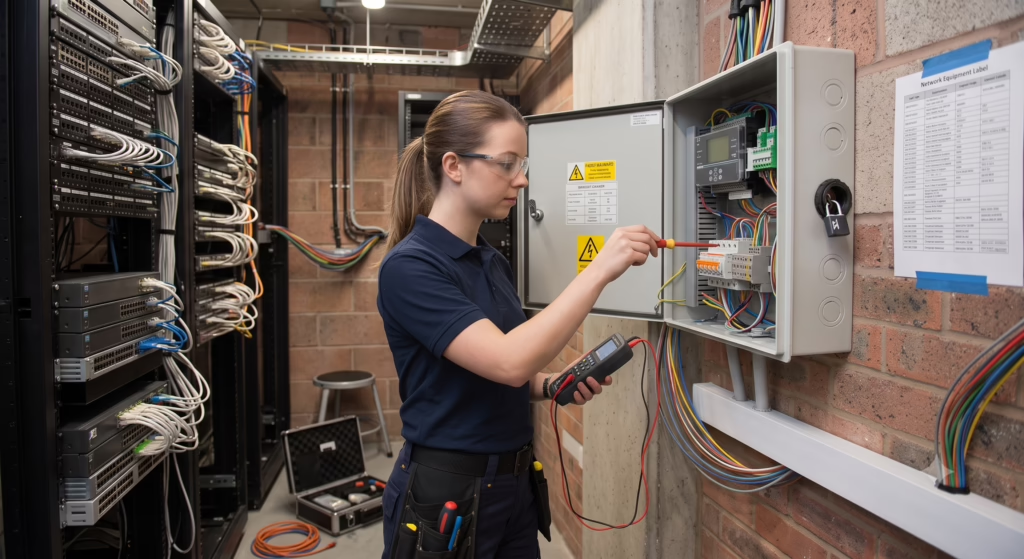
A security system service agreement moves the discovery point. Instead of finding a degraded component during a failure, an ESI technician finds it during a scheduled inspection, while the system is still running. We inspect and test access control hardware and credentials, check camera health and recording integrity, verify power and backup systems, update firmware, and confirm the system still meets the standards it needs to. When something is wearing out, you replace it on a planned visit during business hours instead of paying for an emergency dispatch on a weekend.
The cost picture changes with it, and the math behind break-fix versus a service contract shows why. Emergency service is the most expensive way to fix anything: after-hours labor, expedited parts, and a technician driving out on short notice. A facility without an agreement absorbs those costs reactively, every time something breaks, with no way to predict when. A facility on an agreement trades that unpredictability for scheduled visits that catch most problems before they become emergencies, plus priority response on the failures that still happen. Over a year, the reactive path almost always costs more, and it costs the most at the moments you can least afford it.
What downtime looks like across critical systems
When more than one system fails at once, which happens more than facility managers expect, the workarounds become their own problem. Staff prop secured doors open. Access gets managed by hand. Security tasks land on people who were never trained on the system. Footage that should exist does not. After the repair, someone has to restore the original configuration and reestablish the protocols that were dropped during the outage. That recovery work rarely shows up in any cost estimate, and on a multi-system site it can take longer than the repair itself.
This is the case for treating maintenance as part of the system rather than an afterthought. A facility in Fort Collins, Loveland, Greeley, Colorado Springs, Monument, or anywhere we cover runs the same risk: a system that looks fine until it is not, with the cost landing all at once.
How to find out where your facility stands
The fastest way to know your exposure is to have someone inspect what you currently have. A degraded reader, a drive that quietly stopped writing, or a retention window that shrank as cameras were added is the kind of thing a technician finds in an hour and a facility manager finds during a crisis. ESI services systems we installed and systems other integrators installed, and we can bring an existing system into a maintenance program either way.
If your facility in Fort Collins, Colorado Springs, or anywhere across Northern and Southern Colorado runs a commercial security system without a service agreement, it is worth a short conversation about what coverage makes sense. Call ESI at (970) 999-1681 in Fort Collins or (719) 602-7336 in Colorado Springs, or use the contact form at esicorp.com. A site assessment shows what is already starting to fail and what an agreement would cover before the next outage finds it for you.
Frequently asked questions
How much does security system downtime cost a commercial facility?
It depends on what failed and what that system protected. The repair itself is usually minor. The larger cost is operational: secured areas left open, missing footage during an incident, manual workarounds, staff time, and liability exposure while the system is down. For most commercial facilities, the cost of being down for a day or two exceeds the cost of the repair.
Is a service agreement cheaper than paying for repairs as they happen?
For most facilities, yes, over a full year. Emergency repairs carry the highest cost: after-hours labor, expedited parts, and short-notice dispatch. A service agreement replaces unpredictable reactive costs with scheduled visits that catch problems early, plus priority response when something does break. The reactive path tends to cost more and concentrates that cost at the worst moments.
Can ESI service a security system another company installed?
Yes. ESI maintains access control, video surveillance, and intrusion detection systems regardless of who installed them. We can assess an existing system, bring it up to current standards, and add it to a maintenance program. Older systems often have problems that have been degrading silently, which an inspection surfaces quickly.
What does ESI check during a maintenance visit?
A visit covers the hardware and the software. Technicians inspect and test access control devices and credentials, check camera image quality and recording integrity, verify power and backup systems, update firmware, and confirm the system meets current standards. The goal is to find wear and configuration drift while the system is still working, so replacements happen on a planned visit instead of during a failure.
Last updated: June 2026